Showing posts with label office 365. Show all posts

Wednesday, July 20, 2016

Yammer's back. Microsoft updates the de facto social media client for the Enterprise


If you work in a company of any size chances are Microsoft technologies are the backbone of IT which means there's probably an Office 365 enterprise subscription.

Far removed from it's humble roots as a standalone productivity suite with Outlook's public folders as your primary collaboration source we now enjoy collaboration features that we'd never dreamed of back in the old days.

It really started with OneNote, then came SharePoint to extend the fun to other people and with acquisitions like Skype and Yammer, collaboration is almost a given in the modern enterprise.

But some features worked better than others and Microsoft has a bad habit of changing things without notice or letting features die on the vine.

For awhile it seemed like Yammer was going to be one of those withering features until recently. 
In case you didn't know...

Yammer is a private social networking service that allows communication and collaboration between users in the same enterprise.  Before the Microsoft acquisition access was limited to those within the same email domain.  Microsoft tightened that up by using AD membership but there was still work to do in the 2 years since it became part of Office 365.

Today a major update was announced that allows even tighter integration on windows domains as well as new collaboration features and on the admin end the ability to merge yammer user domains.  A handy feature with all those mergers and acquisitions going on in the corporate world. 

The video below comes from Microsoft and does a better job of explaining the updates to the service than I could.  

It's worth a look...


Thursday, May 30, 2013

IT Legacies or IT curse

Legacy, whenever the word comes up I think of characters like Don Corleone, Michael Jordan and Bill Gates.  Legacy means at some point you've left something that will endure long after you've moved on.
In IT, legacies are usually synonymous with curses and lately I've been doing a lot of cursing.  I've inherited a legacy of sorts with the start of a new contract. 

It's with an industrial electronics company with an IT history that stretches back at least as far as Novell Netware from the piles of old software I've found.

From what I've been able to gather from sources inside the company as well as former IT employees (now acting as fair weather consultants) there was a time when IT was ruled with an iron fist.  The head of the gang of six, as I now refer to them, was an unpleasant database administrator.   His rule was absolute because databases and specifically the data within them are this company's lifeblood. 

In case you haven't gotten the picture yet, he who holds the keys to the data holds the company by the short hairs.  A legacy that's persisted to the present day.  A legacy that now haunts my every billable hour.
To say that the previous IT manager abused his position would be an understatement.  The only force that could displace him and eventually the entire gang of six was when technology began to make it possible to bypass him. 

The tipping point? When someone made the decision to move a critical resource, messaging, out of his control and into the cloud.  Not that it was ever of any real concern to him but this sudden defiance of his rule was taken as a bad omen of things to come.  For him it was time to abdicate the throne.

Remember, up to that point, his rule was absolute like some tyrannical overlord.  User concerns were of no concern with unbridled shouting matches the norm if any dared question the authority of the gang of six.  By the way, the primary duty of the gang of six was to massage the data.   Everything else was secondary and it's still evident in the present day.

Not long after the overlord's departure the remaining gang members found themselves in an uncomfortable position.  Instead of tightly regimented tasks assigned by their overlord they now had to support an unpredictable user base.  A role they seemed unsuited for from the evidence I've uncovered so far.

There was even one who did nothing all day except "cleanse" the data.  Which for all intents and purposes involved little more than editing spreadsheets produced by the overlords many data mines.

Say what you want about Microsoft's Office 365 but I for one have a new found respect for anything that would get rid of that kind of IT organization. 

Shortly after the overlord exited the company in a huff due to the peasant revolt and subsequent embracing of cloud democracy other members of the gang of six soon fell away. 

Fast forward to the present day and open on me sifting through the remains of an abandoned IT department.

Surprisingly, instead of boxes or assorted refuse piled up in some kind of dilbertesque cubicle nightmare,  I find dedicated office space.  There's actual doors, desks, rooms and even a workshop with the remains of long abandoned projects still waiting for attention on the workbenches along the wall.

It's a little spooky, like someone let loose with a neutron bomb.  I keep looking for those outlined shadows on the walls that look like the photo negative of somebody's shadow.  Thankfully, I haven't found any yet.

Somebody was trying to be organized at some point but like the old saying goes, the proof is in the pudding.  I'll put it to you this way, I don't think Bill Cosby will be doing any commercials for these guys.

As I start my third week I already have bad memories.  One of the worst was working on what should have been a relatively simple project with one of the former gang of six (now a consultant).  It was a simple PC swap but the wrinkles became evident all too soon.  The now "consultant" refused to come onsite turning what should have been a day's work into three.   When things went wrong it wasn't the disembodied voice on the speakerphone that had to bear the brunt of a fuming department head.

 Unforeseen complications that should have been addressed in a lab instead of on the production floor almost cost the company thousands in lost revenue.  Quick and dirty fixes instead of solid solutions ruled the day. 
It's not that he didn't mean well but the lack of planning and laissez faire attitude toward the critical nature of this aspect of the business bothered me.  When I discussed it with the site supervisor he recognized the attitude immediately.  It was no different under the rule of the overlord.

IT is a dynamic affair and no one day is like the next but there is always ample opportunity for good planning that includes a fallback position if something goes wrong.  At this company it seems things going wrong are the order of the day. 

As I traverse the lonely halls and rows of cubicles I see evidence of the same kind of haphazard deployment and lack of planning that have crippled IT in the organization.  In short, the tyrants didn't need to burn the castle as they fled, it was already crumbling.

By now it's become obvious to me that IT people that massage databases for a living aren't always the best qualified to make decisions for an entire organization.  Some things are better left to those of us who'd rather not spend our time memorizing SQL queries and worrying about primary keys.

Let me be blunt.  I respect someone who has the ability to manage huge volumes of data and understand the intricacies of how it all relates to each other.  In the end, however, these people are power users not network or system administrators.  There's simply too much to keep track of in both disciplines for anyone to perform both functions competently.   Defy that logic and you end up with an organization like the one I'm trying to piece back together.

Shortly before I arrived the company suffered something largely unheard of in IT these days.  A rampant virus infection.  Caused by ineffective security policies, lack of management tools and outdated security software, it was an inevitable event just waiting for an opportunity.

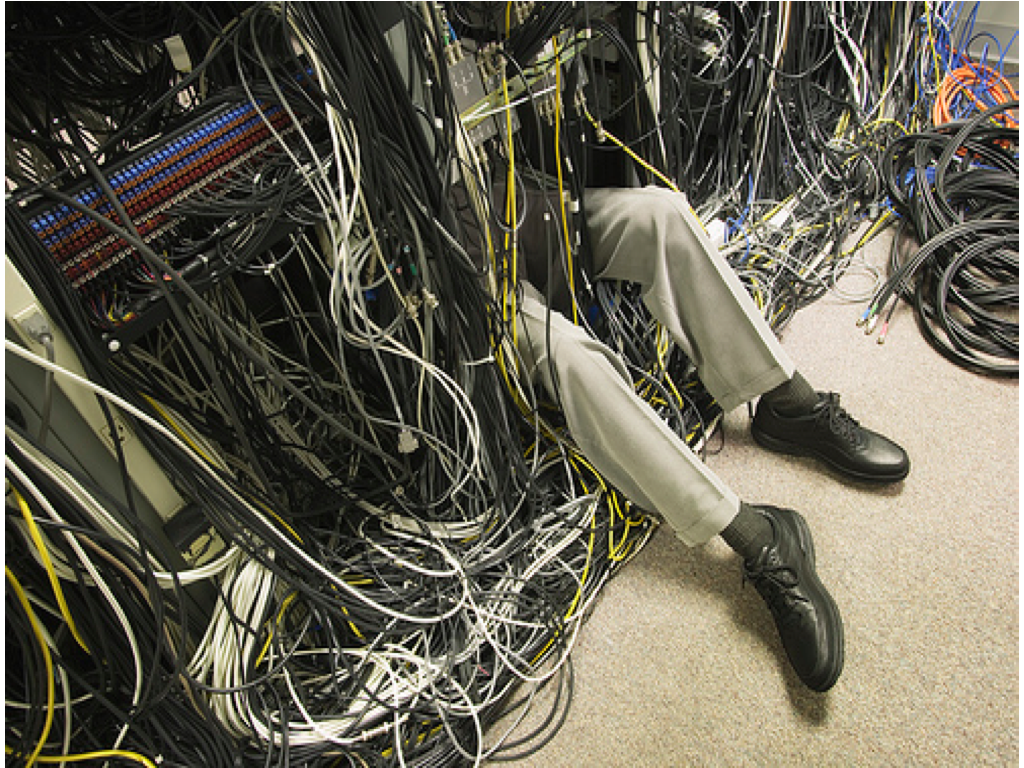
Token gestures of security like a recently implemented mandatory password policy are good but trivial in the context of a broken IT organization. Make no mistake, this is a broken IT organization.  Its most poignant  symbol,  a four foot high pile of discarded rack servers numbering in the dozens just inside the door of the abandoned IT workshop.  With the relative dearth of IT services available it seems more like evidence of a scorched earth policy than evidence of a virtualization project. 

Truth be told many likely became unnecessary with the move to cloud services and a "sort of" consolidation of physical servers into virtual.  Ultimately, however, it seems more like evidence of retaliation than consolidation.  Ask any system admin, for example,  how many Domain controllers should exist in ANY Windows network and the answer you'll get is 2. 

We currently have one and it lives on a virtual server with no backup and no failover.  That's one of my priority projects by the way.  I'm utilizing a discarded hulk and parts scavenged from the carcasses of similarly afflicted hardware.

Questionable licensing, inadequate resources and a lack of documentation are all symptoms of an IT organization in disarray.  When the answer to "What's the admin password" requires a phone call to an outside party for the answer you know you have issues. 

In short, my job is to try to rebuild an IT organization while trying to convince a wary executive suite that I seek no term as the next IT overlord

The most significant hurdle has little to do with a new server or software, however.  Years of abuse from a bad IT organization has made every purchase and every policy change, no matter how insignificant, an exercise in bureaucracy.  A trait that has seen others (not of the gang of six) leave after only hours.
There's such distaste for the way things were that I'm relegated to cubeville, far away from those cozy IT digs.

My story is ongoing and luckily much of my remedial work can take place after hours where I'm free to curse the names of my predecessors without concern for delicate ears. 

The lesson here can be summed up in one of the first meetings I had with my site supervisor.  We were discussing how the IT organization should be structured in the future.  Remember, right now I'm the entire IT department apart from a few specialized "consultants" still massaging the data.

He thought the organization should be headed up by yet another maestro of data to which I replied, " So you're ok with the way things were?"

He replied, " Well, no, it was awful" 

Don't get me wrong, data's important and this company lives and dies by it.  Thing is, I see a future with at least two people to keep this place humming along.  One a data specialist, the other concentrating on the network and server infrastructure.  Both can offer support and with a properly running IT shop, both will have plenty of time to support the user community instead of putting out fires and making excuses.


...and both will be equals.

Thursday, October 11, 2012

The Pitfalls of Virtualization - Part 1 A little history


At the start let me quiet your fears, I'm not going to bash virtualization or the cloud, they're great options.  I'd even go so far as to say they're fast becoming the de facto standard for dealing with your data.

First a little history because contrary to popular belief virtualization was not present at the Big Bang.

When virtualization was in its infancy the promise was great but the future not so certain.  There was more chance of your office PC running a Linux distro than I.T. trusting their infrastructure to a server that didn't have a physical off button.   Virtualization was immature and more often than not when something bad happened there was little chance of recovery.  Worse, compatibility problems with operating systems left many deployments relegated to a corner running a few instances of UBUNTU.  I.T. was still suffering from the implosion of the tech bubble and didn't need another reason to worry about their jobs. 

Sometime around 2007 virtualization became acceptable.  Corporate bean counters liked the idea of doing more with less.  Hardware and storage costs were falling and Virtualization gained credibility when large companies coming up on hardware refresh cycles decided to make the move. 

VMware, Microsoft and Citrix responded with their own offerings promising ease of administration, lower energy costs  and better use of hardware.  It wasn't uncommon, for example, for the average windows server to only be using 40% of its capacity at any time.  Virtualization promised to fix that.

How times have changed.  Now you're hard pressed to find server hardware dedicated to something other than virtualization in any organization of size.   Gone are the days of hovering around the lobby waiting for your RAID controller to show up so you can get your new Exchange server up and running.  Now, a few clicks, an ISO image and you can have a new server online in minutes. 

Unfortunately, virtualization is a victim of its own success.  The bean counters have become addicted to the whole concept of more with less resulting in more downward pressure on  I.T. budgets. 
As a result, more often than not when I run into an organization heavily dependent on virtualization the hardware is at least 5 years old and probably repurposed from something else.  I recently walked into a multimillion dollar company, for example,  that was relying on second hand hardware sourced from EBay to run their virtual server farm!

I'm all for recycling but no server is immortal regardless of the operating system it's running and after awhile hardware will start to fail.  With the rapid pace of Moore's law it's not uncommon to find parts availability for servers relegated to the secondary market within 2 years.   Server hardware still tends to be proprietary and unlike your home computer isn't available at Newegg.  If it's obsolete you roll the dice and hope that hot deal on EBay isn't for something worse than what you already have.

The promise of cheap or free frequently guts reason, however, forcing I.T. departments into less than best practices.

Continued in Part 2

The Pitfalls of Virtualization - Part 2 Virtual Realities!


So it seems that virtualization's benefits can be quickly negated by an overly zealous accounting department.

Still the benefits are considerable. 

The aforementioned leveraging of hardware resources, reduced power consumption and the ability to allocate resources on the fly are undeniable benefits.  We're not quite at plug and play, however, and virtualized environments introduce their own caveats. 

Take hardware compatibility for example.  It's actually more of an issue with virtual environments than physical.  Remember we're dealing with layers of abstraction between your operating system and the hardware. Since virtualization vendors know their product can end up on everything from a re-purposed desktop to server class hardware they know better than to t try to support every configuration.  That means you're likely to be on your own if your chosen platform isn't on their compatibility list.

If your chosen virtual platform doesn't know how to talk to your SAN adapter, for example,  you're at a standstill if it's not on the compatibility list.  Nothing like trolling forums for support while your Fortune 500 company waits.   The same can be said for physical servers but a virtual host usually serves more than one virtual machine which just added an unwanted exponent to your headache. 

It takes some time to figure out the nuances of managing a virtualized environment as well.  Keeping in mind that everything you're seeing is largely an artificial construct and not necessarily reality has found more than one administrator scratching his head.

Ignore that fact at your own peril as It's far too easy to over commit a virtual resource and suddenly find alarms because you've overtaxed your processor and evaporated your storage.   Oh yeah, and all those angry voicemails on your phone.

That brings up another annoyance, licensing.  

While VMWARE, for example, will allow you to have a fully functional virtual host ready to accept as many virtual machines as you can throw at it for free, scaling that up to enterprise level can be an exercise in futility. 

Just like Microsoft, figuring out what you need is never straightforward and usually involves engaging a consultant unless you like to pay for things you don't need.  I've yet to walk into a VMware shop that had the right licensing mostly because the IT director decided to just wing it.  Unfortunately that route usually means the loss of much of the functionality virtualization offers. 

Just for fun, I went online searching for licensing packs for VMware and found a dozen vendors selling 100 concurrent user licenses for $25000.  They all had the exact same description which told me nothing about the product aside from how much better my life would be should I make the purchase.  It makes me miss the days of shrink-wrapped software.  Back then, I didn't need a 5 figure consultant just to figure out how to spend my money!

It seems the more user friendly things get the more money I have to pay someone to explain it to me.

We wrap it up in Part 3

The Pitfalls of Virtualization - Part 3 The Cloud


So if you really don't want to deal with the pitfalls of your own virtual infrastructure you have the option to use someone else's.  

Yes, I'm talking about the cloud which promises unlimited potential so long as your internet connection is working.

Bean counters like the cloud too.  After all to them it's almost free.  No hardware costs, no support overhead and virtually no downtime just a monthly invoice.

That's the promise at least...

Far beyond simple cloud storage from services like Dropbox, software as a service and hosted services via the cloud offered cost savings over the traditional model of keeping it all onsite. 

The highest profile players in the space currently are Microsoft (of course) and Google.  Both are more than happy to rent you their infrastructure for a "nominal" fee. 

The early days of this kind of service tended to over promise and under deliver.  Outages, bankruptcy, vague Service Level Agreements (SLA's) and questionable security hindered adoption.  

Imagine a law firm storing its confidential client files with a cloud provider who suddenly goes out of business. 

A good System Admin knows better than to put all their eggs in one basket but the question of who owned the data in the cloud still remained.  Could they trust that the data would be returned or destroyed if the unlucky provider went under? 

Around the same time Software as a Service(SAS) vendors came along promising universal access to business applications via the cloud.  Data protection showed up via something called software escrow.  Software Escrow promised your data would be safe with a third party should something go wrong.  

Salesforce and Google docs were the first examples but because of the vagaries of their SLA's most businesses decided to stick with their local office suites from vendors like Microsoft. 

Speaking of Microsoft...

Seeing an opportunity to appease the bean counters in the face of resistance to  their ever increasing software licensing costs they came up with Office 365 and Windows Azure.  Moving responsibility for messaging and data to Microsoft's cloud not only reduced infrastructure costs but in some cases headcount.  Why have a legion of IT professionals when any problem could be solved with a phone call?

There's nothing wrong with the logic but sometimes the execution can leave something to be desired.  Salesforce seems to have an outage at least once a year  and Microsoft Office 365 users have found themselves relying on smartphone messaging when hosted exchange servers go MIA.  Lest we forget the troubles with Google's cloud services. 

The hidden costs of cloud services have to come into play at some point.  Nothing's free as many a surprised supervisor has found when faced with a bill for his users going over their mailbox limit.  The purported cost savings in the server room can quickly be offset by the subscription model employed by cloud providers.

Just because I.T. services have moved out of the office and into the datacenter doesn't mean you don't have to pay for them. 

Cloud providers usually have tiered SLA offerings which means how fast they deal with an issue is directly related to how much you're paying.  If it's a system wide issue the SLA goes out the window.

Of course nothing's perfect and highlighting the flaws is no condemnation.  For the most part cloud services have lived up to their claims.  Like anything else the wise IT Pro knows not to rely on anything  exclusively.   Google docs offline? Work with a local copy.   Hosted Exchange services down?  Chances are you have more than one email account available to you elsewhere.

At this point the bloom is off the rose.  Virtualization is approaching the ubiquitous and there's no turning back.  Chances are at least some of the applications you work with every day have at least some portion living in the cloud.

That's not a bad thing just know that it's not the only thing.  As the old saying goes don't put all your eggs in one basket.